Author: Shane Curran

  • Fuelling the Craft.

    ” Take care of your body. It’s the only place you have to live.”

    – Jim Rohn.
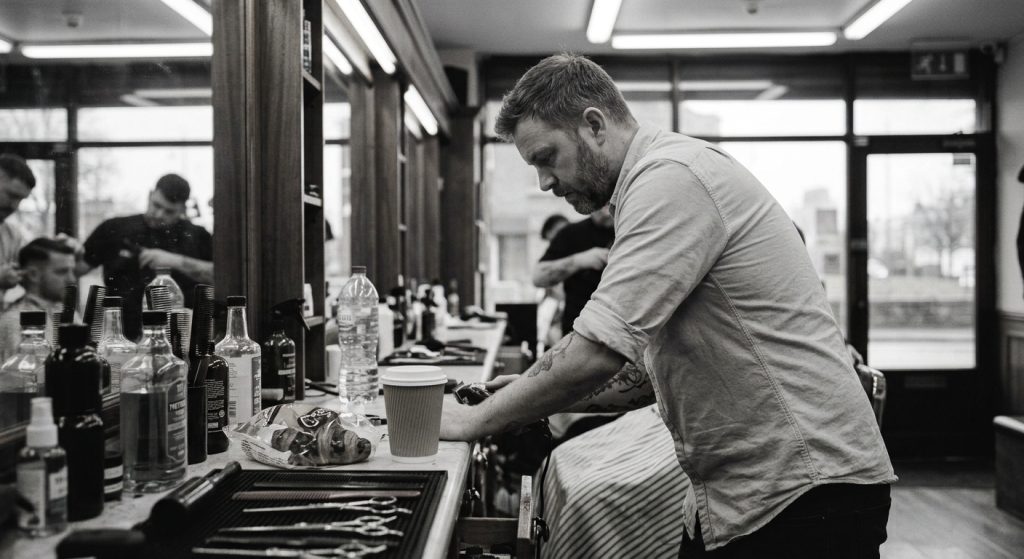
    ” A lunch break? What’s that?” I laughed, as a customer asked me what time I took my lunch at.

    My standard reply was to tell them a story from my apprenticeship of my Boss telling myself and another apprentice that he didn’t give us lunch breaks, because it would take him too long to train us back in afterwards.

    There was probably more than a grain of truth in his claim to be honest. Once you stopped cutting, swept up, gathered up the towels and gowns, grabbed a quick sandwich and maybe sat down for a few minutes, it could be surprisingly difficult to get momentum back. It turns out Newton’s First Law applies to barbers just as much as it does to physics.

    A body at rest tends to stay at rest.

    Looking back at it, though, I wonder if that mindset stayed with me long after my apprenticeship ended. Somewhere along the way, skipping lunch became “the way”. Something that happened occasionally eventually became my default setting.

    Like the two old sailors in Jaws comparing scars, barbers and hairdressers can end up swapping tales of missed lunches and who went longer without eating. The hours without food, the clients squeezed in back-to-back until the day is over. We almost wear this as a badge of honour.

    The problem is, not every tradition we inherit is one we should keep. It can become a habit that quietly chips away at our energy, concentration and, over time, our health.

    For years, not eating was just part of the job.

    If the shop was busy, I just kept going. Always telling myself “I’ll get something after the next customer”. Before I knew it, the clock was hitting 5 o’clock. And I wondered why I was tired and irritable.

    It wasn’t dedication.

    It was neglect.

    The skipped lunch leads to the energy crash. The coffee and chocolate croissant become the quick fix. For a while, we feel better, and then the cycle starts again

    The irony is that diabetes runs in my family and I should have known better. But like many people in our trade, I convinced myself that looking after my clients meant putting myself last.

    I’ve come to realise that I had it the wrong way round.
    We Ask a Lot of Our Bodies

    Barbering and hairdressing are physical jobs.

    We’re on our feet for hours. We’re constantly moving our bodies, concentrating on fine detail, making hundreds of small decisions, talking to people all day and trying to give every client the same standard of service.

    That takes energy.

    Yet somehow, many of us expect our bodies to perform like high-end machines while running on little more than caffeine, sugar and good intentions.

    Imagine expecting your car to run without petrol or your clippers to run all day without charging them.

    We’d never expect it.

    So why do we expect it from ourselves?
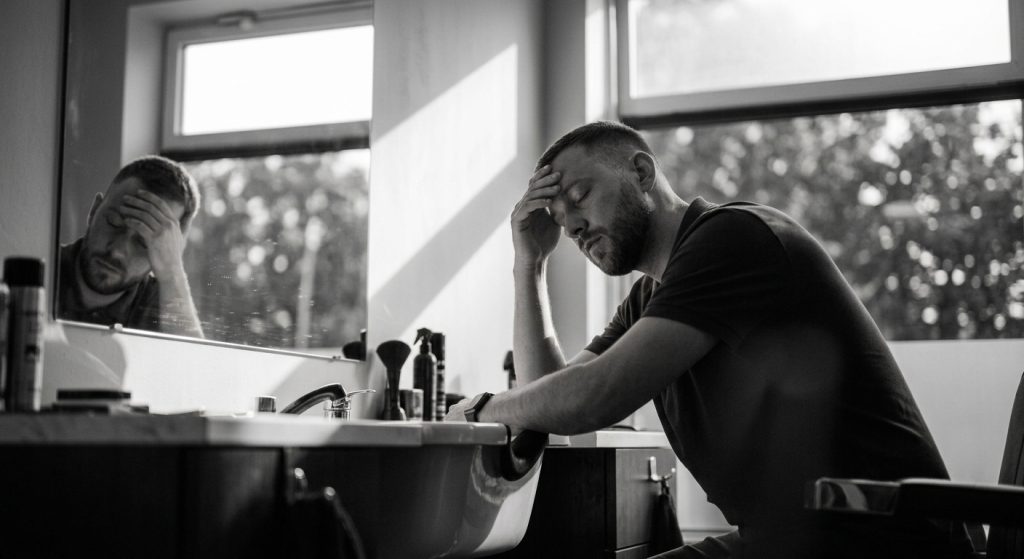
    The Afternoon Crash

    Most of us know exactly when it happens.

    Around three or four o’clock, the tiredness creeps in.

    Your concentration wanders a little.

    You become a little less patient.

    Your posture starts to sag.

    The packet of biscuits in the staff room suddenly looks like a sensible lunch.

    I’ve been there more times than I care to admit.

    The problem isn’t just that we feel hungry.

    The problem is that we’re asking our brains and bodies to continue producing skilled work without giving them the fuel they need.

    The Drink We Forget

    Food isn’t the only thing we neglect.

    Water is often forgotten about too.

    I’ve had days where I’ve been so busy and so caught up in the rhythm of the shop that I’ve looked at the clock late in the afternoon and realised I could barely remember drinking anything at all.

    How many times have you finished a busy day and realised your water bottle is still almost full?

    Standing all day, talking constantly, working under warm lights and living on coffee can leave us dehydrated without even realising it.

    Sometimes that afternoon headache or foggy feeling isn’t because we’ve worked too hard.

    Sometimes we’re simply thirsty.
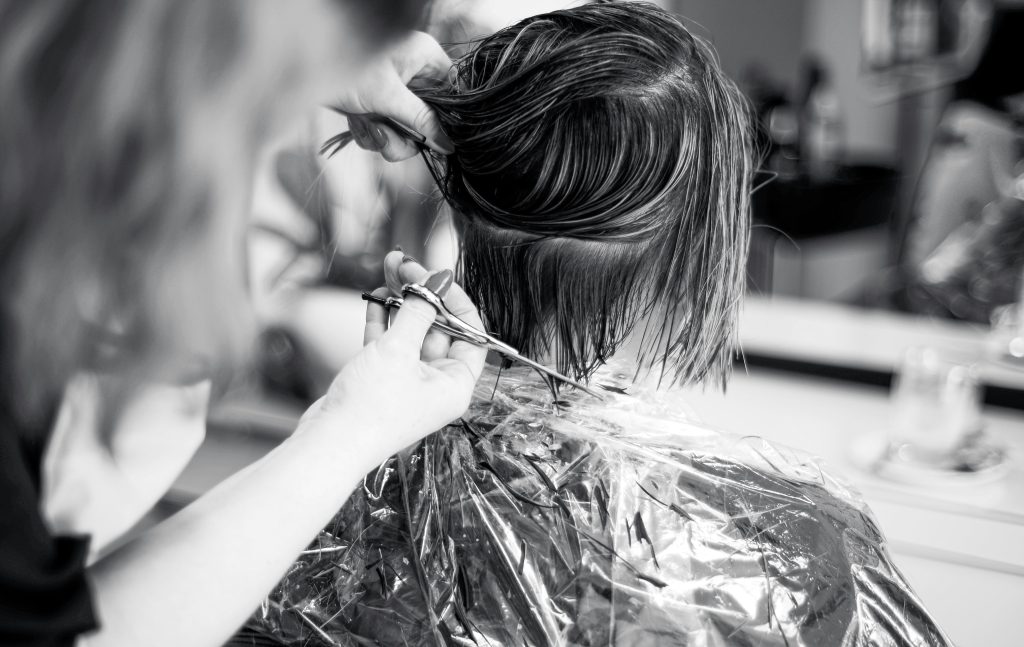
    Photo by Gabriela on Unsplash

    Looking After Yourself Is Looking After Your Clients

    This is probably the biggest lesson I’ve learned.

    For years, I thought taking five minutes to eat was taking time away from my clients.

    Now I see it differently.

    When I’ve eaten properly and stayed hydrated, I concentrate better.

    I’m more patient.

    I make better decisions.

    I have more energy.

    My last client of the day deserves the same attention as my first.

    Looking after myself isn’t something I do instead of looking after my clients.

    It’s one of the ways I look after them.

    It Doesn’t Have to Be Perfect

    This isn’t about counting calories or following the latest diet trend.

    It’s about building habits that help us feel better and support us during our work.

    Maybe that means bringing a sandwich instead of relying on the nearest vending machine.

    Maybe it’s keeping a bottle of water beside your station.

    Maybe it’s having a banana or a handful of nuts between appointments instead of reaching for another chocolate bar.

    Small changes, repeated consistently, usually beat big changes that last a week.
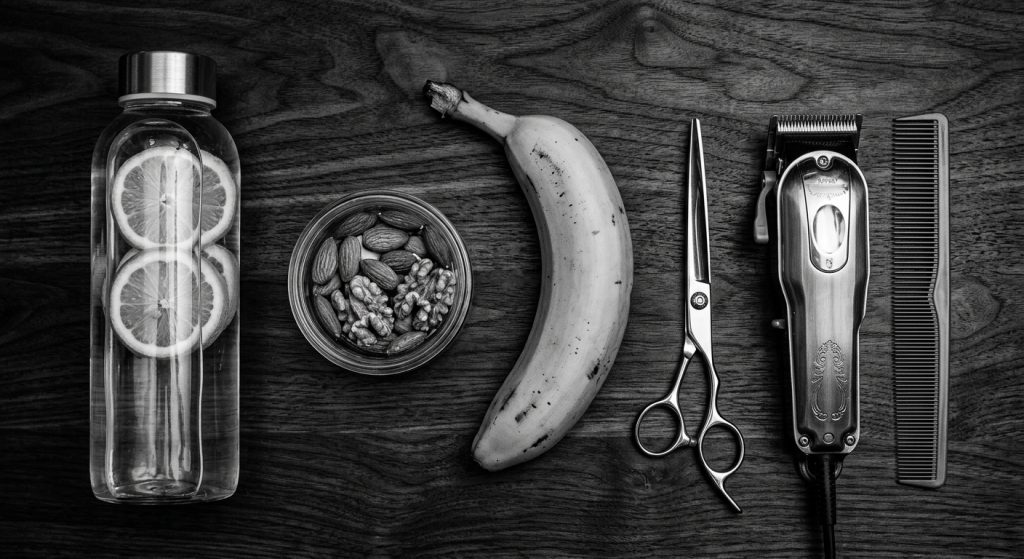
    Food Is Part of the Toolkit

    We invest in good scissors.

    We replace worn-out clippers.

    We pay for courses to improve our skills.

    But the most important tool in the shop is the one standing behind the chair.

    If we want long, healthy careers doing the craft we love, we have to look after that tool too.

    Because eating well isn’t about being healthier for the sake of it.

    It’s about having the energy to do our best work.

    It’s about serving our clients well.

    It’s about making sure that twenty years from now we’re still able to enjoy the job that first made us pick up a pair of scissors.

    So this week, don’t try to change everything.

    Just drink a little more water.

    Eat one proper meal during your shift.

    Keep one healthier snack within reach.

    Because this isn’t really about lunch. It’s about the career we’re building.

    We want to be good enough at our craft to keep doing it for years. We want to have the energy to enjoy it, the health to sustain it and the ability to give our clients our best.

    So perhaps looking after ourselves isn’t something that comes after the work.

    Perhaps it’s part of the work.
  • Two hearts are better than one. 

    Photo by The New York Public Library on Unsplash

    “ The strength of the team is each individual member, the strength of each member is the team.”

    – Phil Jackson. Legendary U.S. Basketball Coach.

    Success has always had the habit of hiding its best work in the shadows. We celebrate the “overnight success” that took twenty years to build blissfully aware of the toil behind the scenes of joy. We admire the finished article or performance while rarely seeing or acknowledging the hours, days and years of quiet work that made it possible. As Muhammad Ali said “ the fight is won or lost far away from the witnesses…”

    Our bodies are no different. Some of the hardest working parts of the human body go unnoticed until something goes wrong. None more so than our calves, often called the body’s second heart.

    Why Your Calves Matter.

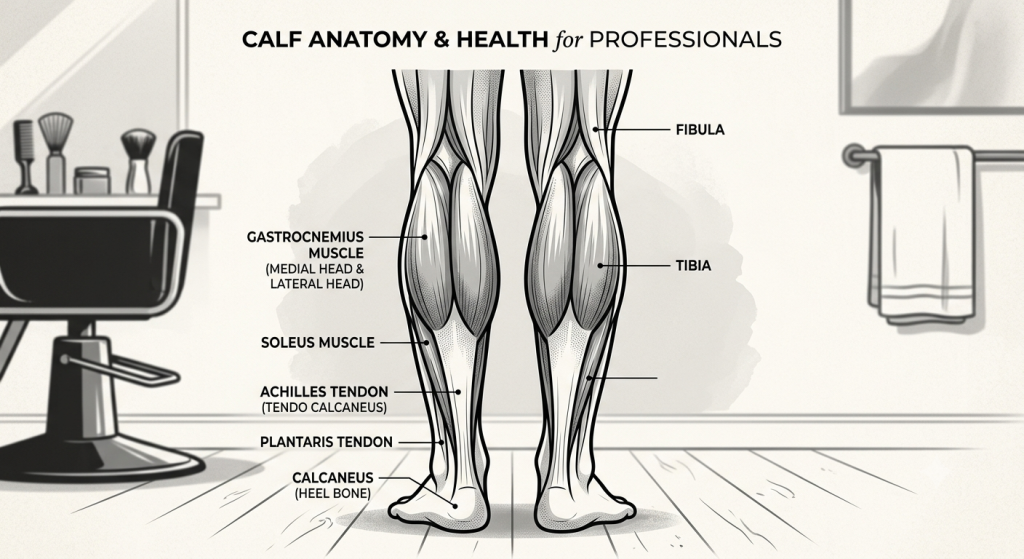
    Most people think of the calves as the muscles that help us walk or run. In reality they’re working every minute we’re on the salon floor. Whether you’re stepping around the chair, leaning into a fade, colouring hair, reaching across a client or simply standing waiting for your next appointment , your calves are making thousands of tiny adjustments to keep you balanced and upright. Your calves are actually made up of two muscles working together ,the larger gastrocnemius and the deeper soleus ,connected to your heel through the Achilles tendon. These partners spend hours helping us maintain posture while standing.

    The Body’s Second Heart.

    Every time our calves contract they help squeeze blood back towards the heart by compressing the deep veins in the lower leg. this is often called the calf muscle pump. It helps to prevent backflow and reduces the workload on the heart. This led to them being called “ The Second Heart” . Walking, climbing stairs and regular movement activate this system. Standing still behind a chair for long periods does not, which can be a contributing factor to that heavy legged feeling, swollen ankles or tired feet at the end of a long hard day in the salon. 

    Photo by Gavin Allanwood on Unsplash

    The Hidden Cost of Standing All Day.

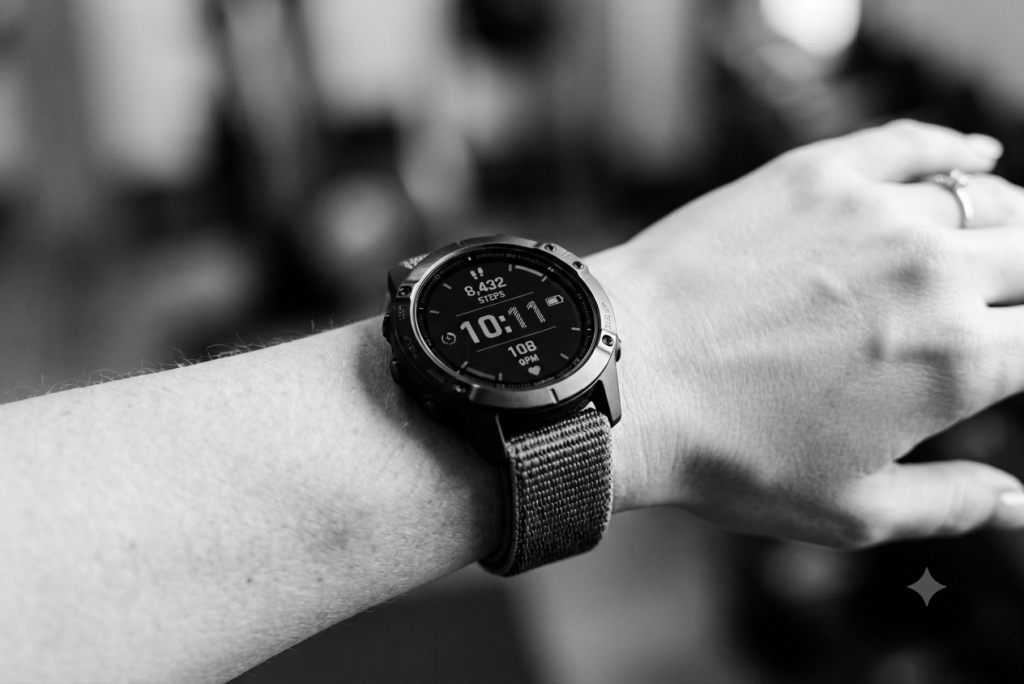
    Standing and moving are not the same thing. We often work within a surprisingly small area around the chair. The first time I wore a fitness tracker I smugly thought I would SMASH the World step record. 10,000 steps? Easy. Imagine my surprise and shock when I found I had clocked less then 4,000 steps. Over time, this lack of movement and prolonged standing may contribute to tight calves, reduced ankle mobility, aching feet, Achilles irritation, heavy or swollen legs and increased pressure in the veins that may contribute to varicose veins or blood clots in people who are already predisposed.

    Looking After Your ‘Second Hearts’.

    There’s no magic bullet or exercise, but small changes and habits can make a big difference : a small walk between clients if possible, change your stance, a few calf raises behind the chair between clients, stretch at the end of the day, strengthen your calves as part of your regular training and good footwear will go a long way.

    I’ve spent over 30 years behind a Barbers chair. Looking after your body doesn’t require perfection, it doesn’t require complicated routines and it’s not even about aesthetic’s. More often, it’s about paying attention to the quiet workers that support you every day.

    The people in your chair may never notice your calves, and that’s fine, but if you look after them they will quietly and efficiently carry you through another busy week behind the chair. Success isn’t only built by the work everyone sees. Sometimes it’s built by the parts nobody notices, including the two muscles that quietly carry you through every day behind the chair.

    Photo by Adam Winger on Unsplash

    Look after your second hearts, and they’ll spend a lifetime looking after you.

  • The Body Takes the Shape of the Work We Do

    “The chains of habit are too weak to be felt until they are too strong to be broken.” — Samuel Johnson

    A man walks into a Gym and the Coach tells him:

    “You walk like you’re drunk.”

    No, it’s not the start of a terrible Dad Joke, it’s a comment that one of the best coaches I had ever worked with made to me.

    He told me to face the mirror and look. It was literally staring me in the face but I had never noticed. I mentioned it to friends and family who casually confirmed it. It turns out I was the only one not in on this secret.

    Three decades of cutting hair had shaped my body the way centuries of water had carved out the Grand Canyon. Slowly, incrementally, imperceptibly. My left shoulder was higher than my right. My hips were twisted slightly and my pelvis was tilted.

    How had I missed this? What other skeletons were in my closet that had slipped by?

    So I started paying attention.

    And once I did, I began to see things I had never really considered before.

    My weight didn’t sit evenly through both feet. It tended to drift to my right side. My right hip sat slightly differently to my left. Even the way I moved around felt a little off balance.

    None of it had happened suddenly. And none of it caused immediate pain.

    It was simply the result of something much quieter.

    Thirty-four years behind a barber’s chair.

    What repetition looks like in real life

    Most people don’t think of barbering as physically repetitive in a way that shapes the body.

    But when you break a day down, it is.

    We lean into cuts.

    We reach across the chair.

    We step around the same space hundreds of times.

    We shift our weight to see a better angle.

    We turn in the same directions over and over again.

    Individually, none of those movements mean much.

    But repeated thousands of times a year, for decades, they begin to add up.

    And the body doesn’t ignore repetition.

    It adapts to it.

    Not because it’s failing, but because it’s efficient.

    Photo by Richard Stachmann on Unsplash

    Becoming aware of what you’ve always done

    What surprised me most wasn’t what I noticed about my stance.

    It was the fact that I had never noticed it before.

    Once I became aware of how I stood, I started noticing other things too.

    How I loaded one leg more than the other without thinking about it.

    How my hip would naturally rotate into a familiar position when I was working.

    How my weight shifted across my feet depending on where I was in the shop.

    And how all of that seemed to influence the way my knees and ankles were working beneath it.

    None of this came from a formal assessment or a structured plan.

    It came from simply paying attention.

    Photo by Buddha Elemental 3D on Unsplash

    Everything is connected

    One of the things barbering teaches you, if you pay attention long enough, is that nothing really works in isolation.

    How you stand affects how you move.

    How you move affects how you distribute weight.

    How you distribute weight affects how your joints behave.

    Not in a dramatic or immediate way.

    But gradually.

    Quietly.

    Over years.

    That doesn’t mean every ache or imbalance has a simple cause. The body is far more complex than that.

    But it does mean that small, repeated habits are never neutral.

    Photo by Hari Perisetla on Unsplash

    The shift that changed things for me

    I didn’t try to fix anything after that conversation.

    I didn’t start a new routine or go looking for exercises.

    What changed first was awareness.

    I started noticing how I moved around the chair.

    Whether I was always stepping in the same direction.

    Whether I was leaning when I didn’t need to.

    Whether I was adapting my body to the position of the client instead of adjusting the client’s position to suit me.

    That was the shift.

    Not correction.

    Just awareness.

    Moving with a bit more intention

    Over time, that awareness changed how I worked.

    I walk around the chair a bit more now instead of always reaching.

    I change my stance more often during the day.

    I notice when I’ve been loading the same leg for too long.

    I reset my position between clients without thinking too much about it.

    None of it is dramatic.

    Most clients wouldn’t notice any difference at all.

    But I notice it.

    And more importantly, my body notices it by the end of a long week.

    A career built on repetitions

    As barbers and hairdressers, we often measure progress in skill.

    Better fades.

    Cleaner lines.

    Faster work.

    More confidence.

    But while we’re improving our craft, our bodies are also learning something.

    They’re learning from repetition too.

    Every working day is quietly teaching them how to move, how to stand, and how to load weight.

    The question is not whether the body is learning.

    It is.

    The question is what it is learning.

    Photo by Ryoji Iwata on Unsplash

    You can’t change what you don’t notice

    For me, the biggest lesson wasn’t about posture or symmetry.

    It was about attention.

    Because nothing really changed until I saw it.

    And once I saw it, I couldn’t completely unsee it.

    That awareness didn’t solve everything.

    But it changed how I work.

    And sometimes that’s enough.

    Not perfection.

    Just a bit more intention in how you move through the day behind the chair.